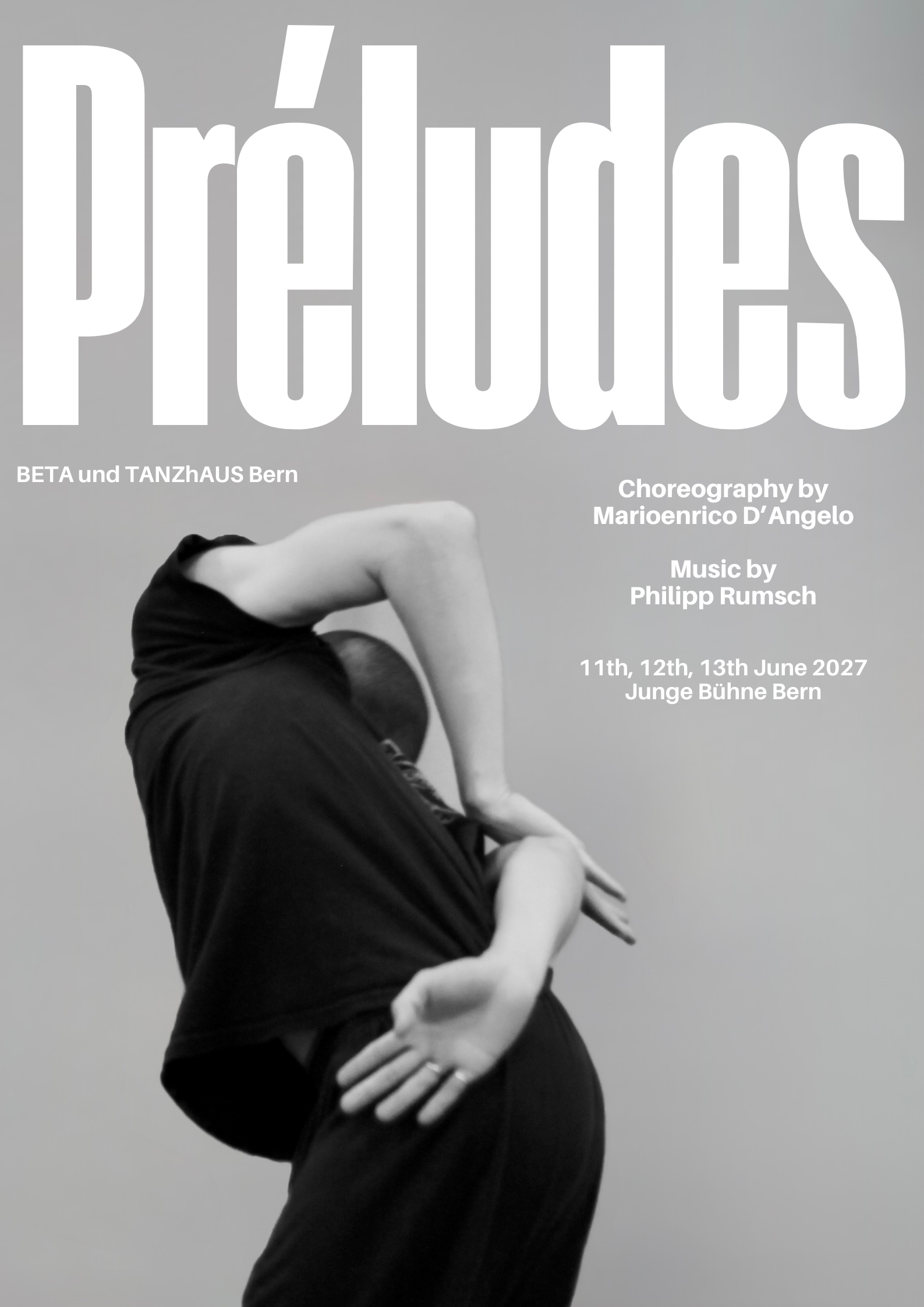
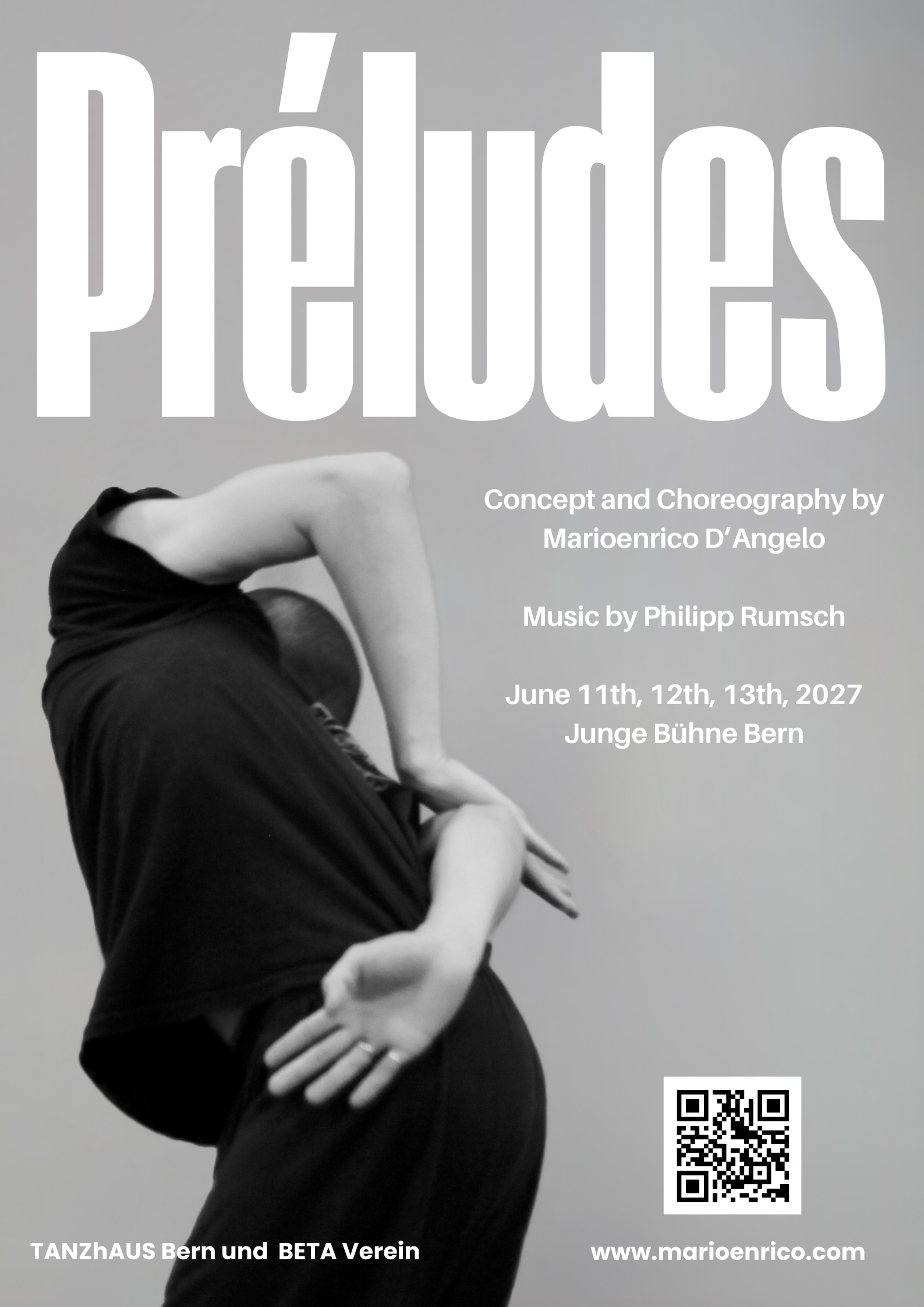
Contemporary Dance performance co-produced by TANZhAUS Bern and BETA Verein (CH)
Performance dates: 11th/12th/13th of June 2027 at the Junge Bühne Bern (CH)
Concept and Choreography by Marioenrico D’Angelo / Music by Philipp Rumsch / Production by Irene Andreetto / Costumes by Catherine Voeffrey / Outside Eye: Kathrin Yvonne Bigler / Mediation and Coaching by Nicole Friedman
Can we still enjoy the present moment fully, knowing that what’s about to come might be bigger, better, or simply different? And what if it isn’t?
Throughout life, it’s easy to feel dissatisfied with what we have and to believe we deserve something better. We pour energy into the next career move or into improving our relationships, convinced that happiness lies just beyond the next milestone. There’s nothing wrong with striving to grow, but when our goals keep shifting, we risk falling into a cycle of “someday” thinking, forever chasing or waiting for a brighter future and forgetting the present.
In music and opera, a prelude, or overture, was originally conceived as an introduction to a work of greater significance. The prelude was born as a simple composition to warm up musicians and focus the audience before the main performance. Over time, preludes evolved into standalone, emotionally rich pieces that showcased the composer’s artistry, becoming symbols of artistic freedom. From Bach’s thematic variations to Chopin’s 24 expressive preludes, and continuing through Debussy, Ravel, Shostakovich, and contemporary composers, the prelude became a genre of independent artistic expression, a celebration of the present without ulterior purpose.
Préludes is a choreographic work for ADULT and teenage audiences (12+) that reflects on the experience of living the present moment as if it were only a prelude to something more significant, a “not yet” that overshadows the value of the here and now. The piece explores this emotional tension and invites audiences to rediscover the significance and weight of the present.
In Préludes, the human body and dance become a grounding and emotionally accessible experience, one that cuts through the noise of a fast, overstimulating world. Through the physicality of the performers, Préludes encourages young and adult audiences to reflect on the value of the present moment and to recognise that the now does not need to be perfect to be meaningful.
In close collaboration with composer and sound designer Philipp Rumsch, the work features an innovative musical score that reimagines the historical form of the prelude through a contemporary lens. His contribution introduces a fresh sonic layer, blending tradition and experimentation to create a cohesive and immersive sound world.
Préludes themes, waiting, anticipation, emotional closeness, identity formation, and comparison, are deeply connected to the lived experiences of everyone, but particularly to those of young people. This project holds significant pedagogical relevance for teenage audiences. Adolescence is one of these pivotal transitional periods: a time of rapid growth when individuals are “neither child nor adult,” waiting to be recognised as autonomous while still subject to others' authority. Today’s teenagers often feel suspended between stages, caught in a constant anticipation of something better and more meaningful, an experience intensified by the pressures and comparisons of the digital world, where someone else’s “perfect” life is always just a scroll away, and where constant comparison fuels performance anxiety and reinforces the fear of “not being enough”. The piece addresses these realities by working through embodied expression rather than explanation. It offers teenagers new ways to understand and relate to their emotions.
Workshops & Post-Show Discussions
Artistic expression plays a vital role in the development and well-being of young people. Engaging with the arts supports emotional regulation, self-discovery, and communication, skills that are essential during adolescence. It enhances cognitive skills such as problem-solving, imagination, and flexible thinking, while also fostering empathy and strengthening social bonds. In a time when many teenagers struggle with stress, mental health challenges, and digital overload, dance and other art forms offer a crucial space for connection, reflection, and personal empowerment. Dance reconnects teenagers to the physical world, encouraging sensory awareness, emotional regulation, presence, attention, and an embodied sense of identity. In this way, it offers a powerful antidote to digital overload and supports their overall well-being.
For these reasons, we aim to organise workshops and post-show discussions in collaboration with schools and youth centres. The workshops give young people the opportunity to experience their bodies and emotions through new artistic pathways, encouraging creativity, confidence, and collaborative exploration. Post-show discussions provide an open and moderated space where students can ask questions, articulate their impressions, and connect the themes of the performance to their own lives. These conversations deepen understanding, strengthen the impact of the artistic experience, and create a bridge between the performance and the social and emotional realities of young audiences.
Cultural Manager Nicole Friedman, responsible for the educational programme for children and young people at the Migros Culture Percentage Dance Festival Steps and co-director of the YOUNG DANCE festival, will advise the Préludes team throughout the project. She will define the pedagogical materials needed by teachers and will help develop a dedicated workshop tailored to the piece.
In 2026, prior to the start of the creation process, we will organise dance workshops with the Tanzclub Youngstars group in Bern. Youngstars is a contemporary dance group for teenagers supported by Bern Ballett and Bühnen Bern, and led by Dance Educator Karin Hermes. Karin Hermes has agreed to host choreographer Marioenrico D’Angelo and dancer Andrey Alves, who will facilitate a series of workshops with the group’s young members. These workshops will allow the Préludes team to engage directly with teenage dancers, gathering their perspectives on the project’s themes and artistic approach. The sessions will also open a dialogue about dance today, exploring what kinds of performances, movement qualities, and artistic languages resonate most strongly with young generations. This exchange will guide the creation process and make sure the work stays closely connected to the experiences and sensibilities of its intended audience.
Artistic Process
‘‘My artistic process is rooted in an ongoing dialogue between physical exploration and conceptual ideas. In my movement research, I work with physical tasks, actions that generate textures, sensations, emotions, or atmospheres within the body. At the same time, I build movement from conceptual ideas, shaping each scene according to the emotional or thematic landscape it requires. This dual approach, physical research and conceptual intention, forms the foundation of my choreographic language.
My practice is grounded in contemporary dance, understood as a broad and porous field that embraces a wide range of movement qualities. I approach contemporary dance not as a fixed style but as a methodology of openness, adaptability, and dialogue with other forms, drawing from diverse influences, including contact improvisation, traditional dances, ballet, dance theatre, and urban and ballroom techniques. These inspirations converge in a movement language that is both precise and expressive, abstract yet emotionally resonant.
Marioenrico D’Angelo